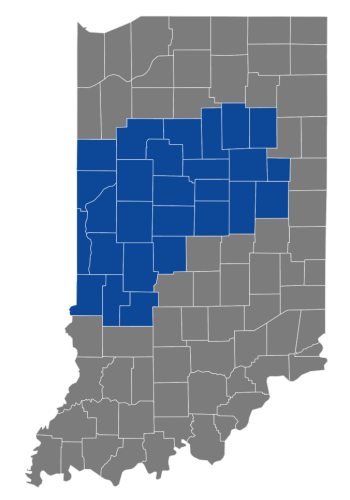
Government building overhead door installation in Indiana covers courthouses, fire stations, public works garages, and municipal maintenance shops — facilities where the door has to pass a bid spec, survive daily fleet traffic, and keep running without a change order six months later. Fairmount Door installs and services commercial overhead doors for Indiana government facilities, and the spec work matters more here than on a private warehouse because a failed door becomes a public record.
- Fairmount Door handles commercial overhead door installation for government buildings across Indiana, from fire stations to public works garages.
- Match cycle-count rating to actual daily use — a 25,000-cycle door fails fast in a station running 10+ cycles a day.
- Fire-rated doors carrying 20-minute to 3-hour UL ratings are non-negotiable on shared-wall municipal buildings.
- Indiana’s fiscal year starts July 1 — bid timing should follow that calendar, not the calendar year.
- A maintenance contract signed at installation beats one negotiated after the first breakdown.
Why overhead door installation matters for government buildings
A garage door on a house is a comfort issue. A garage door on a fire station apron is an operations issue — if apparatus can't roll out fast, response time reporting takes the hit and someone explains it at a council meeting.
Government facilities also run on a different clock than a retail buildout. Bids go out against a fiscal year that starts July 1 in Indiana, procurement rules require a documented spec before a purchase order gets cut, and downtime on a public works garage or courthouse loading dock becomes a line item somebody has to justify. Commercial overhead door repair for government buildings already deals with this reality on the maintenance side — installation is where you avoid creating that reality in the first place.
Steps to get a government building overhead door installed right
Write the bid spec before you call anyone
A vague RFP ('commercial garage door, good quality') gets you the cheapest bid, not the right door. Write the technical requirements into the document itself.
- State a minimum cycle-count rating: 25,000 for light-use bays, 100,000+ for daily-use apparatus bays
- Specify steel gauge — 24-gauge is standard commercial, heavier gauge for high-traffic docks
- Require a documented fire rating (20-minute to 3-hour UL) for any shared-wall installation
- Set an insulation R-value range for heated bays instead of writing 'insulated'
- Include ADA clear-opening width for any publicly accessible entrance
Match cycle-count rating to actual daily use
Count how many times the door actually opens and closes in a day, multiply by operating days, and compare that against the manufacturer's rated cycle life before signing off on a spec. A door rated for 25,000 cycles in a fire station running 15 cycles a day burns through its rated life in under five years.
- Log actual daily opens for two weeks on the busiest bay
- Compare that count against the door's published cycle rating, not its price point
- Require the cycle-count rating in writing from every bidder
- Cross-check operator horsepower and duty cycle against door weight
- Reference cycle count rating guidance directly in the RFP language
Once the manual counting is done, Fairmount Door specs cycle-count-rated commercial overhead doors and operators for Indiana municipal facilities that need something built for daily fleet traffic instead of a light-duty door pushed past its rating.
Build fire rating and code compliance into the spec
A fire-rated overhead door isn't optional on shared-wall municipal buildings — it's a code requirement that shows up in the plan review, not something you patch in after the inspector flags it.
- Confirm which wall assemblies trigger a fire-rating requirement before you draft the spec
- Require a documented UL listing from every bidder, not a verbal assurance
- Check egress width against current life-safety code for the occupancy type
- Keep inspection paperwork on file — auditors ask for it years later
Add security hardware to the base spec, not as a change order
Evidence rooms, IT equipment bays, and vehicle impound garages need more than a standard lock cylinder. Bidding security hardware separately after award almost always forces a second procurement cycle.
- Slide bolts or interior security bars on doors facing public-access areas
- Keyed override compatible with the facility's existing master key system
- Mounting points ready for camera or access-control integration
- Documented hardware spec in the original RFP, not a post-award addendum
Plan insulation and winterization for unheated bays
A salt-storage building doesn't need the same R-value as a heated administrative garage, and specifying one insulation standard across every bay wastes budget.
- Set a separate R-value target for heated versus unheated bays
- Spec weatherstripping and bottom seals rated for Indiana winter temperature swings
- Confirm the operator's cold-weather duty rating if the bay stays below freezing
Lock in a maintenance contract before the door goes into service
A door installed without a follow-up service schedule degrades quietly until something fails during a shift change. Build the maintenance line into the same procurement as the installation.
- Quarterly inspection covering springs, cables, and hinges
- Photo-eye and safety-reversal testing on a documented schedule
- Written service log kept on file for audit purposes
- Response-time commitment for emergency service calls
Budget across fiscal years, not as one lump sum
Installation, maintenance, and eventual replacement rarely fit in a single fiscal year's line item, and treating them as one number is how facilities end up deferring maintenance until a door fails.
- Installation cost booked in the current fiscal year
- Maintenance contract as a recurring line item starting the following fiscal year
- A replacement reserve line for doors approaching end of rated cycle life
- Bid documentation retained for the procurement audit trail
Get a bid-ready overhead door spec
Fairmount Door writes commercial overhead door specs for Indiana government facilities.
Comparison: overhead door options for government facilities
| Option | Best for | Key limitation | Verdict |
|---|---|---|---|
| Standard steel sectional door | Public works garages with moderate daily traffic | Cycle life shortens fast without an upgraded rating | Hold |
| Insulated steel sectional door | Heated bays and shared-wall municipal buildings | Higher upfront spec complexity for bidders | Buy |
| Rolling steel/coiling door | Tight-headroom loading docks and evidence bays | Slower cycle speed than sectional doors | Hold |
| Fire-rated overhead door | Facilities with shared-wall occupied space | Requires documented UL listing and inspection paperwork | Buy |
| High-cycle door with heavy-duty operator | Fire stations and public works running 10+ cycles daily | Higher spec cost than light-duty alternatives | Buy |
Common mistakes government facilities make on overhead door installation
- Specifying a light-duty commercial door for an apparatus bay running 10+ cycles a day — it burns through its rated cycle life in under five years
- Skipping fire-rating documentation on shared-wall builds, then failing inspection after the door is already installed
- Budgeting installation but not the maintenance contract, so testing and adjustment never happens until something breaks
- Bidding late in the fiscal year and forcing a rushed 2026 install before funds lapse
- Leaving security hardware as a change order instead of the base spec, which triggers a second bid cycle
FAQ
What’s the best overhead door for a fire station apparatus bay?
A high-cycle commercial door rated for 100,000+ cycles with a heavy-duty operator is the standard for fire stations. Anything rated below that fails early in a bay running multiple daily cycles.
Is a fire-rated overhead door required for government buildings?
It depends on the wall assembly and occupancy type, but shared-wall municipal buildings commonly require a documented UL rating between 20 minutes and 3 hours. Confirm the requirement during plan review, not after installation.
How much does commercial overhead door installation cost for a government building?
Cost depends on door size, fire rating, insulation spec, and cycle-count rating, so it varies project to project. Get a written quote against your bid spec rather than relying on a single published number.
How long does installation take for a commercial overhead door?
Timelines vary by door type, permit review, and site prep, so coordinate the installation window with your facility’s fiscal year and bid schedule to avoid a rushed 2026 install.
Can a garage door company install doors for a public bid project?
Yes — a licensed commercial installer like Fairmount Door works directly against bid-spec documentation for Indiana municipal facilities. Confirm the installer can supply the cycle-count and fire-rating documentation your RFP requires.
What cycle-count rating should a government garage door have?
Light-use bays typically need a 25,000-cycle rating, while apparatus bays and busy public works garages need 100,000+ cycles. Log actual daily opens before choosing between the two.
How often should a government facility’s overhead door get serviced?
Quarterly inspection covering springs, cables, hinges, and safety-reversal testing is standard for high-traffic municipal doors. Put the schedule in writing as part of the installation contract, not as a future add-on.
One last thing
The single change that prevents most repeat bid cycles on these projects: write the cycle-count rating and fire-rating requirement into the RFP itself, not the change order. Facilities that bid a vague spec in 2026 and add hardware or fire rating after award almost always end up back in procurement within a year.
Related guides
- Best fire-rated overhead doors for commercial buildings
- How to set up a maintenance contract for overhead doors
- How to budget for a commercial overhead door replacement project